Friday, October 21, 2011

Over the river and through the woods and into the classroom we go...

Well, I (Andy) have been wanting to articulate some of my experience and am finally sitting down to do so. I am working very closely with Mr. Joseph Cayatano, the local manager (think superintendent of schools) as we travel to schools, observe teachers, tour facilities and attend staff meetings. There are thirty schools in the Toledo district under the care of Catholic management and our goal is to visit every school at least once per term. This translates into travelling anywhere between 2-4 hours every Tuesday and Thursday during the week. The roads are rough, unpaved, rocky and sometimes flooded. One trip to the village of San Benito Poite required us to wade through 2 flooded creeks to be sure that the truck could safely cross the swelled creeks. Although the terrain is similar what one might see in a commercial for a Ford F-350 Super Duty truck, our vehicles pale in comparison. In Joe's own words, "We have two trucks available. The first is okay, and the second, well, it will get you there." The ride on these days is rough but it helps to think of it more like a rough massage through some of the most beautiful county I have ever seen. Tall mountains, large green plants, and rushing rivers remind me that this is God's country, still very hidden and isolated from the rest of the world.

As we arrive at schools, we are welcomed by the principal and given a quick update on the news of the day, whether it be the construction of a latrine, the status of the school's feeding program, or relations with the village community. While Joe stays with the principal to review attendance logs and staff registers, I take to the classrooms. This is the part that I love, being able to observe classrooms in action. I try my best to "sneak in" without disturbing the class. It is not easy since the students are well trained to stand and provide the usual choral greeting, "good afternoon Sir". It is especially difficult to be in cognito in the younger grades as these students stare at the unique looking stranger.

Within a few minutes, the class resumes its regular pace and I get to to be a fly on the wall. I take this time to view the room, the layout of the desks, and various charts and signs that the teacher has posted around the room. No pre-made commercially available alphabet charts, safety posters or motivational signs here. Every character, rules poster, and academic sign has been painstakingly drawn and colored by the teacher and each has at least a few years of use under it's belt.   There is a very long and specific list of essential charts that the government requires to be present in each and every classroom including national symbols, alphabet in both English and Spanish, and manners protocol.

 After familiarizing myself with the physical setting, I start to observe the teacher's interaction with the students, his/her classroom management and lesson delivery. During this time, I try to record at least 2-3 good points to offer some praise and reinforcement. As a teacher, I always liked it when an observer recognized the positive aspects of my teaching. The more difficult task is to mention the not so positive aspects in a supportive manner. I have been trying to phrase my criticism in the form of open questions. "How will you redirect the student in the back who has been distracting those around him?" "What strategies have you found to be successful when it comes to getting the class's attention?" "How will you assess if the students understand the lesson's objectives?" My goal is to gently bring these issues to light and offer some reflective direction.  Oftentimes, the teacher and I have had the opportunity to discuss these observations face to face during a break time.  This has been a most interesting lesson in tactfulness and relationship building as I am expected to observe and offer suggestions, while trying to be more of a coach than a critical voice. I feel that my suggestions have been well received, which is something that I'm always worried about. I certainly do not want to offend anyone and no teacher wants someone to walk into their room and point out faults.  One of the more unfortunate realities that one teacher commented on is that young Belizean teachers find it difficult to admit the areas that need improvement.  On the other hand, there certainly is some very good and effective teaching going on here.
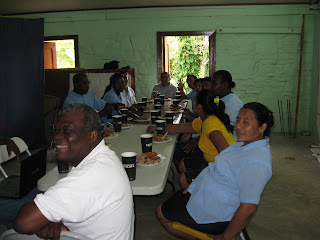
Typically, our staff meetings do not include a meal such as
 this.  Today, the staff was celebrating a farewell
 baby shower for their Vice Principal.
One of the things that I like to point out when we hold staff meetings is that, in my experience, most practical professional learning comes from colleagues, not from degree programs or workshops. I try to encourage these younger teachers to seek help from those veteran staff they work with.  Near the end of our stay, Joe and I spend some time with the staff (numbering anywhere from 3-12 teachers) discussing these best practices.  I am always very pleased with the dialogue that emerges from these sessions.  It has proven to me that teachers can be their own best resource and, if they are given the time to reflect and share, they can certainly learn a lot from one another.  Good teaching is the same no matter where you are. It comes down to dedicated individuals who are willing to do what they can in the best interests of their students.  I hope to share more of these experiences, but will have to wait for future posts to do so.


Tuesday, October 4, 2011

Independence!

September is the month of independence for Belizeans and they make no buts about it, it is a celebration worthy of month long festivities. Starting at the end of August one can find houses, cars, windows and shops adorned with the Belizean flag. I would have to say that I've never seen a display of patriotism to the extent that the Belizeans go. This year is extra special as it is the 30th year anniversary of Belize's independence. To give you an idea as to how young this country is their founding father, George Cadle Price (the equivalent to our George Washington), just passed away a few weeks ago.
The month starts off with a Carnival type parade and a queen pageant in Belize City. However, with fewer than 6000 residents, the town of Punta Gorda does surprisingly well with their own Independence celebrations. Earlier in the month the country celebrated the Battle of St. George's Caye which was a decisive battle between the British and the Spaniards over the country of Belize (the British won out). There was a presentation of the pageant queen along with a fireman's parade followed by a demonstration from the Belize Defense Force (BDF) This was followed by a party in Central Park, complete with music, dancing, and a dj. That was just the beginning.
As the month ensued so did the celebrations. The government organizes what they call the Children's Rally. The idea is to give the children their own opportunity to celebrate their country and to display their patriotism. Many classes head to the local civic center during school hours to participate. Representatives from all of the schools in the surrounding Punta Gorda area then gathered together and paraded around the streets, waving flags, beating drums and carrying school banners. Preschools, such as our son's, had government appointed buses that were decorated and participated in the parade as well--shouting "hip hip hooray" along the route. As the parade wrapped up and the kids headed home (who can have school after that right?) the government paid for to each child to be sent home with a treat or goody bag of treats and a juice bottle. We went on the bus with our son's preschool, our two oldest daughters walked with their school and our youngest daughter watched the parade from her classroom as it went by. It was really a great experience to see so many children all supporting their country in such a public way.
On September 21, Belizeans celebrate their independence--the day when they were officially no longer a British colony. The celebrations here tend to be more communal than familial and they begin on Sep. 20 (Independence Eve). The majority of festivities took place at Central Park and included a bounce house (yay for my kids), beer, food, political speakers, music and dj. There was also some amazing authentic garifuna music that was performed by a group from one of Toledo district's only garifuna villages, Barranco (see youtube link for some video footage). They make heavy use of drums, rattles, and tortoise shells as instruments. At 11:45 p.m. the BDF marched into Central Park and did a 21 gun salute. After that was the countdown to midnight. As the clock struck midnight fireworks were set off at the pier a few blocks away. We were extremely impressed as they were as good as any suburban US city's fireworks. The festivities went until 2 a.m. but that was just too late for this young family, we left by 12:30 a.m.
The next morning, Independence Day, began with a large rally and another 21 gun salute (the BDF sure like their guns). This was followed up with a large parade that had representatives from nearly every school and organization in the area. Andy was very happy to see a troop of Boy Scouts marching in the parade all decked out in uniform. As the parade wrapped up, there was more music, food, and festivities in the park but because of the long night and hot weather, we just didn't last too long. Later that afternoon was a bike race in which participants had to bike around the town's main streets 12 times. Some of the participants came decked in proper biking gear and multiple speed bikes while others wore street clothes and flip flops and rode their basic 1 speed bikes. We didn't get to see who finished but I believe there was a $250 prize for first place.
The month has wrapped up with a memorial service for George Cadle Price, the founding father, first prime minister and leader of People's United Party. The kids were off school and there was a special mass and procession to Central Park for an ecumenical service. Simultaneously, there was a funeral mass in Belmopan (the capital city) followed by a burial in Belize City. We do not have a TV signal nor do we get a good radio signal but riding around town, it was very apparent how well Mr. Price was loved and revered. Nearly every house in town had either a tv or a radio tuned to the solemn, all day service.
Celebrating Belize's independence has been a real treat for us. Not only was it a great time but it was wonderful to see so many people come together for a common purpose.


Monday, September 19, 2011

It's Out of My Control

When we moved here I decided to start a personal journal, a new concept for me. Granted, I haven't exactly made regular journal entries but when I do, I often find it to be an uplifting experience. One of the main reasons is that when I get back to the States, I don't want to reread a journal full of complaints, and negativity. Therefore, I tend to work to steer my writings into a more positive direction. And when I do, I find that often God opens me up to a particular lesson or awareness that I might not have otherwise realized (I'd encourage you give it a try as well). Today's journal entry was a good realization for me and so I thought I'd share the gist of it with you.
As I was in the middle of writing today, we were stricken with another power outage. Only this time, upon investigation, we realized that it was not a blackout but rather, the electric co. had shut off the power to our apartment. Apparently, the landlord had gotten the bill and failed to share it with us, resulting in a non-payment and subsequent shut off (just 10 days after the bill was due mind you). We immediately paid the bill but were told that it'd be all day before power would be restored.
The irony of this is that I was in the middle of journaling about how living here has been a real lesson in patience. Things break, all the time. Things get fixed, very slowly or not at all. Appointments get scheduled, circumstances sometimes result in reschedules. Grocery lists get made, items are regularly missing from the store shelves. It's easy to view these all as bad things but living here has taught me that with the bad, comes a lot of good as well. "Belizean time," as we like to call it, forces me to spend a lot less time being angry and feeling stressed--it just is no way to live. It really does force a person to slow down and not be in such a hurry all the time. The result, I believe, is a lot let stress in our lives. In spite of the struggles that many Belizeans face (whether they know it or not) I tend to see them as living far less stressful lives than their American counterparts.
So as I began to ponder this--wonder why I don't live this way in the States--and reflect on how changes can be made in my personal life as I return to the U.S.. I feel like I finally can begin to understand it now. So much of one's life is out of our hands and living here makes that incredibly obvious. The problem is that in the States, with our modern conveniences, our 8 hr workdays, and our ability to fill up our free time with errands, activities, and subsequent obligations, we inherently come to feel that we are in control of our lives. And the more we try to control, the more stressed we feel. Now hear this: God is in control, not us. In Jeremiah 29:11 He makes that very clear. 'For I know the plans I have for you,' declares the Lord, 'plans to prosper you and not to harm you, plans to give you hope and a future.' If I just stop, step back, and choose to stop feeling the burden of everything I'm involved in then I'm giving it up to God--the one who is and should be in control and the one who wants nothing but the best for us. Choosing to put it out of my control at all times is what I've done here out of necessity but only now have I come to learn that actually it's a necessity everywhere in the world not just here. We must stop wrestling with our Savior to be in charge--we'll never win that battle anyway. I'd encourage you to try it yourself as well, in all aspects of your life. I'm sure that once you do, you too will feel liberated by the freedom that ensues. God can handle it all and if we'd just let Him do His job of loving and caring for us, then He'll remove the stress and fill us with the peace that can only come from Him. Now, I feel so good to be able to say "it's out of my control." It makes life feel like what it's actually supposed to be, and that is good.

Sunday, September 11, 2011

Texas Hold 'Em Fundraiser

This fundraiser is being organized by some close friends and supporters.  Sounds like a fun event!  Please help by sharing this link with your friends.  RSVP is on the bottom of the flyer.

Thursday, September 8, 2011

Tropical Rain

   When you live in the tropics you experience tropical weather, plain and simple.  We live in the tropics.  Where we live gets 160+ inches of rain each year.  That's a lot of rain.  Bear in mind that the majority of that rain falls during the rainy season (June-Nov.) and about 90% of which falls at night.
   Seeing that we've lived here now for over 2 months, we'd arguably say that we've seen our fair share of rain.
   The one comment that we most often hear from people around here is "are you tolerating those awful storms?" Andy and I never fully understood. We liked the rain, we welcomed it.  Every time it rains the air gets cooled down and the heat becomes that much more bearable.  If it had been up to us, we'd want it to rain every night.  (Though really it pretty much does.)
   Well last night, we finally understood what they've all been talking about.  Three nights in a row now we've had big storms.  The 2nd night included a power outage that had all 5 of the kids awake and unsettled.  When we lose power in this town at night it gets black and we're talking pitch-black-unable-to-see-your-hand-in-front-of-your-face-black.  When it gets that dark it's hard to move around let alone work to calm the fears of 5 frightened children.  Needless to say it was a long night that night.
   Thanks to our daughters' homemade rain gauge, we've been able to keep track of the rain here.  Over the past 3 nights we've received over 9" of rain.  Last night, we got 5" of rain--4 of which fell in about 45 minutes time.  We live on the 2nd floor but no one, and I mean no one can do much to prevent 4" of rain in 45 minutes from wreaking havoc.  Fortunately for us this was another night in which we found ourselves with a frightened child standing over our bed.  As I escorted her back to her bed that's when I realized what the rain had done. It had come up under our front door and flooded half of our living room, hallway, master bedroom and bathroom.  So at 1:30 a.m. we did what we had to do.  We cleaned up the water.  Within 30 minutes we had the water swept up enough to where we felt like we could go to bed.  Our neighbors, Peter's family, didn't fare so well.  They live on the ground floor and had probably 4 times as much water in their house as we had.  It was disheartening to watch them sweep out so much water from their house in the middle of the night.  Yet I would consider their house to be one of the more sturdy structures around.  Many houses here have openings in their walls as well as where the walls meet the roof--a lot of places for rain to come in.  I imagine that there were a lot of people up last night trying to dry out their houses.  I also imagine that a few slept through the storm and awoke to even more water to clean up this morning.  This whole town will be moving a bit slower today.  Nearly everyone will be that much more tired.
   After 2 1/2 months of living here we finally seem to get it.  Rain can certainly be a good thing but it can also create a lot of burden.  It can literally drain you of your energy and leave you feeling depleted.  As we continue to pick up the pieces of last night's storm, we certainly won't take the rain for granted.  Not any time soon anyway.

Sunday, August 28, 2011

Jaguar Preserve

Even though we are here on missionary work and this blog is mostly related to that, I thought it worthy to take a moment to discuss some of our experiences outside of our missionary efforts. These past two months we've been so focused on getting settled and focusing ourselves on service opportunities that it's been all too easy to forget that there is a whole other world outside of Punta Gorda and it's surrounding villages. So we decided to take a much needed excursion before school starts to view some of that world. While we for the most part, subsist on the donations of our supporters, we also have personal funds for just such getaways and this experience was well worth it.
Our family decided to take a two day overnight getaway to Cockscomb Basin Wildlife Sanctuary (aka. Jaguar Preserve). Cockscomb is about 1 1/2 hrs north of PG and it is a jungle basin surrounded by the Maya Mountains. The area is a true rain forest, and thus it is not without it's fair share of beauty. The nature preserve is only about 6 miles off the highway but feels worlds away from civilization. Upon our arrival we were greeted by Gregorio Chun, who owns and operates Tutzil Nah Cottages and Tours. He was an original inhabitant of Quam Bank village, the village forced to relocate once the area was declared a preserve in 1985. 5 Of those families, including the Chun's, relocated 6 miles away under the new name, Maya Center. We stayed on Gregorio's property in simple but clean, and cheap, accommodations. Our original intentions were to spend one day at the nature preserve and one day at a nearby beach but after just a few hours, the decision was unanimous--we skipped the beach and opted for 2 days in the jungle. Because the road into the preserve is unpaved we decided to pay Gregorio to give us a ride there both days. He does do guided tours, which I'm sure are well worth it, but the wealth of info that he shared with us on the ride in was even priceless.
The second day of our visit was definitely the more relaxing day. We rented some inner tubes and took a float down the river. We were able to really observe the rain forest from the river--not only a peaceful experience but also an excellent way to view some of the unique birds there. Our first day was the most active of the two yet uniquely spiritual. We hiked to an amazing waterfall (one of two in the park) and then up to a bluff with gorgeous panoramic views of the Cockscomb Basin and surrounding mountains. The waterfall was cool, clear and shallow and everyone loved the refreshing swim. All the while we kept stopping to think, here we are in a place as beautiful as can be, in a place like what we read about in school! To stop, and soak it all in is nothing short of overwhelming--every flower, every butterfly, every beautiful bird. These are the infinite details that remind us of God's beautiful creation, that of which we are all a part. How amazing it is the way He puts it all together to create such a beautiful world.
Then, to make it up to the top of the bluff, to see the view--that is where both Andy and I can really see God's work. To hike up a mountainside, with a toddler on Andy's back, and myself carrying a 3 year old about half the time stretched us to the limit, physically. But to suddenly get to the point where we find ourselves peering over the trees, into a space of openness--it literally takes my breath away. How could I ever doubt the amazing abilities of God when I get this opportunity to look at his magnificent creation--stretching for miles upon miles? "I will lift up my eyes unto the hills from whence comes my help." (Ps. 121:1) "Great is Yahweh and greatly to be praised in the city of our God, the mountain of His holiness." (Ps. 8:1)"In [His] hands are the depths of the earth; and the height of the hills are His." (Ps. 95:4)
While Belize does have it's fair share of problems--poverty, poor infrastructure, etc--it is one of the most beautiful countries in the Western Hemisphere, if not the entire world. To immerse ourselves in that beauty for a couple of days has proven to be very spiritual & therapeutic for our family. I would gladly recommend a visit to this country to anyone who asks and I'm so thankful that God called us to be here.

Monday, August 15, 2011

Village Church Dedication

(This post is from an experience on day two but we are just now getting around to posting it along with the photos. We hope you find it to be informative nonetheless.)
 Shortly after our arrival in Punta Gorda, the pastor, Fr. Perl, invited us to a church dedication in the village of Delores.  Delores is one of the most remote villages in all of Belize and just a couple of miles from the Guatemalan border.  They had just built a new church and were having a dedication ceremony.  Fr. Perl suggested that it was a unique opportunity and worth the trip.  So in spite of just having traveled 12 hours to reach our final destination in PG, Belize,  myself (Julie) and our 11 year old anxiously awaited our pick up at 7 a.m. the next day.
  While Delores is only about 45 miles away, it takes over 2 hours to get there via bumpy dirt and gravel roads.  Being so new to the country, that didn't bother my daughter and I as there were many interesting sites to take in along the way.
   We passed several villages with houses made of wood and thatched roofs.  To see bare breasted women was not uncommon nor was it unusual to see women and and children bathing in the river.  Chickens and pigs ran loose and we could even see farmers working in their fields (without the advantage of machinery).  The last few villages we passed had solar panels hooked up to their homes (enough to power abut 2 light bulbs) as their only means of electricity.  The village of Delores, however,  has fresh water but no electricity.
   Finally we arrived at Delores.  There is a town center where the church is located and about 300 villagers were waiting.  People had come from neighboring villages (some had literally walked 4 hours to get there) to participate in the celebration.
   The first thing we noticed were the people.  Delores is a Kekchi Mayan village.  Southern Belize is made up of mostly Kekchi Maya but also Mopan Maya.  The Kekchi women have a distinctive plaid skirt and a solid color blouse.  Most noticeable of the Mayan women are that they carry their babies (up to 2 or 3 years old) in a hammock style sling that they wear hanging from their heads (see pics).  Women are usually under 5 feet and by speaking with some of the children, we learned that they tend to run about 6 inches shorter than a typical child in the US.
   Then the festivities began.  They starting things off with a traditional Mayan dance called the Deer Dance.  Only men participated and they wore masks, elaborate capes, and several layers of clothing.  It was great to watch but looked to be very hot (see pics).
   After the dance came the procession.  Villagers, along with the priest, processed into the plaza carrying a crucifix, burning incense, and carrying a statue of St. Peter, all while members sang hymns in their Kekchi language (see pics).  They processed around the church several times, sprinkling holy water on the building and setting off fireworks intermittently.  After the procession was mass but because so many were gathered, mass was held outside.  About half of the service was in English and the other half was in Kekchi (including the Bible readings).
   After mass it was time to eat.  The village had killed 5 pigs 2 days earlier to prepare for the celebration.  The meal consisted of a traditional Mayan dish called caldo (literal translation is "soup") and pach.  Caldo is a spicy broth with large pieces of meat in it (usually one per bowl)--in this case, pork.  Pach is similar to the masa in a tamale minus the filling but a bit more firm and cooked inside a banana leaf.  Both are meant to be eaten with your hands.  Both dishes had been cooked in a communal kitchen over an open fire (see pics).  Being the adventurous eaters that we are, both my daughter and I really enjoyed ourselves.  Clean up was at the town's only clean water source--a spigot near the central plaza--though my daughter and I did notice some villagers drinking the murky water from the creek.
   For it being one of our first experiences in Belize, this was a true delight and a blessing.  Fr. Perl told us that this was probably one of the biggest celebrations he had been to in his 15 years in Belize.